NEOCITIES and the INDIE WEB REVIVAL
an exploration/exhibition, coded and curated by Dana Stanbridge.

By opening this HTML webpage, I am pleased to inform you that you are now participating in the best niche counterculture you've never heard of- the
Indie Web Revival!
At the turn of the millennia, author Darcy DiNucci coined the term Web 2.0: a marked step in the internet's evolution, from a web mostly consisting of static webpages with little participation (except for manual links and emailing), to a networked, participatory, streamlined "social" web. There is much to be said about this transition, but as it pertains to the topic of this exhibition, Web 2.0 saw netizens gradually shifting to “pre-made user interfaces and architectures, where users became active consumers, creators, and participants of a service in which they had very little, if any, agency” (Wagner 125).
With this transition came a loss of interest in staple Web 1.0 platforms. As more user-friendly platforms became the norm, the laborious nature of Geocities quickly lost popularity, and the servers were shut down in 2009. Even MySpace- launched in 2003 as a somewhat transitory platform that was social, but still incorporated the customizable nature of Web 1.0 webpages- was seen as unprofessional in comparison to the sleek aesthetics of the new Facebook (Wagner 126). Removed from its HTML roots, Olina Lialina states that Web 2.0 made the internet “a ‘native’ thing to be ‘experienced’, rather than explicitly interacted with” (Wagner 125).
To expand upon this difference, it’s helpful to reference Katherine Hayles’s paper “Print Is Flat, Code Is Deep”. In this exploration of hypertext, Hayles provides and defines Espen Aarseth’s terms scriptons and textons. According to Aarseth, scriptons are “the surface image” that appear on a digital screen, while textons are “the underlying code” (Hayles 78) that make them manifest. The exact definitions of these terms are subjective, as “readable” information (scriptons) can include HTML and more sophisticated code if the reader can access and understand them. The textons, in this case, would then refer to voltages, or strings of binary code- what the computer “reads”.
With an awareness of the subjective nature of scriptons and textons, one could argue that Web 1.0’s HTML-based webpages provide netizens with access to one extra “layer” of scriptons, by normalizing user interaction with HTML editors. Web 2.0’s pre-made interfaces, on the other hand, obfuscate the relationship between code and image. By rendering participation in coding unnecessary, as well as by making this code inaccessible (or at least difficult to find), casual users only “read” the most surface level scriptons of a digital space. Removing this access, although it may seem trivial, changes the way in which the vast majority of people use the internet. As per Lialina, Web 2.0 is “experienced”, not interacted with- so the platforms who provide this experience have total control over how their users engage with it.
A substantial archiving effort began when Yahoo announced the end of Geocities- but in 2013, after a data breach, MySpace suddenly purged most of its users' content with no warning.
Wagner describes the shock and heartbreak of MySpace’s sudden end. She states that “when a website, especially one that invites mass participation, goes offline or executes a huge dump of its data and resources, it’s as if a smallish Library of Alexandria has been burned to the ground” (Wagner 124). Except for a handful of internet archivists salvaging the wreckage, nobody seems to care about this massive loss of data. Wagner says the reason for this, however, is obvious:
The persistent erasure of what are essentially frozen experiences, snapshots of our lives, nakedly demonstrates how tech monopolies value the human commonality and user experience so loftily promoted in their branding—they don’t (Wagner 124).
The vast majority of data on web 2.0 is personal: posts, videos, artworks, writing. These individual pieces of information are relevant to only a few, sentimental to even fewer- but their combined destruction (as with MySpace) would be a massive, collective loss. This data, however, is ultimately in the hands of tech monopolies, who have the power to purge their platforms without notice if they see fit. When would this destruction of data be warranted, in the eyes of a platform? Why, when it’s a good financial decision, of course.
In 2008, as the “new web” was still coming to fruition, Matthew Allen rather prophetically summarized the power these megacorporations gain from centralizing data:
Web 2.0 … serves as an ideology for the creation of new forms of dependence between individual humans and corporations who, by monopolizing and controlling the network activities through which key forms of human sociality becomes possible, can therefore benefit disproportionately from that dependence (Allen).
Perhaps, in this bleak scene, it becomes obvious why web revivalists wish to return to the simplicity and limitations of Web 1.0. Static webpages allow artists to create a digital embodiment of their work in an environment that they also control: unburdened by algorithms and ad revenue, infinitely customizable (or at least to the level of one’s HTML skills), and free from censorship. And although, like Geocities, the Neocities servers could go offline eventually, having the HTML behind a website means it is chronicled essentially forever. In his manifesto, digital artist Daniel Murray (A.K.A. "Melon") puts it rather beautifully:
HTML has no time, it lasts forever. In 2000 years somewhere on some crystal harddrive, there will be a copy of Melonking.Net and some bored archeologist will explore it again. I make the site for that archaeologist (hello!) (Murray).
In his aforementioned manifesto, Melon also posits that “Economies are based on scarcity …[but] it’s impossible to make a digital asset scarce” (Murray). The web revival recognizes that the endless paywalls, subscriptions, copyrights, and financial barriers that populate the current web are functions of the “streamlined” monopolized internet- that in truth, if the image/text/data is digitally present, it is accessible. This, once again, highlights a key difference between Web 1.0 and Web 2.0: users of the latter, likely having never linked .jpg files in HTML to make them appear on a webpage, may not be aware that this file is hiding (but accessible) in the code of the sites they visit.
The free circulation of digital assets is a core facet of the web revival - “sprite galleries” or other small archival projects proliferate webpages on Neocities, and some of the most visited pages are graphic collections like the ones used for this project. Many users also have master lists of resources for free ebooks and movies, guides on how to pirate art software like photoshop, and other tips for circumventing paywalled digital content.
and HTML is the medium. Alongside the political and anticapitalist motivations of the web revival, this exhibition is a celebration of the endless creativity of Neocities users, who have taken full advantage of the freedom provided by a somewhat daunting from-scratch website.
click the button under each caption to visit each site!
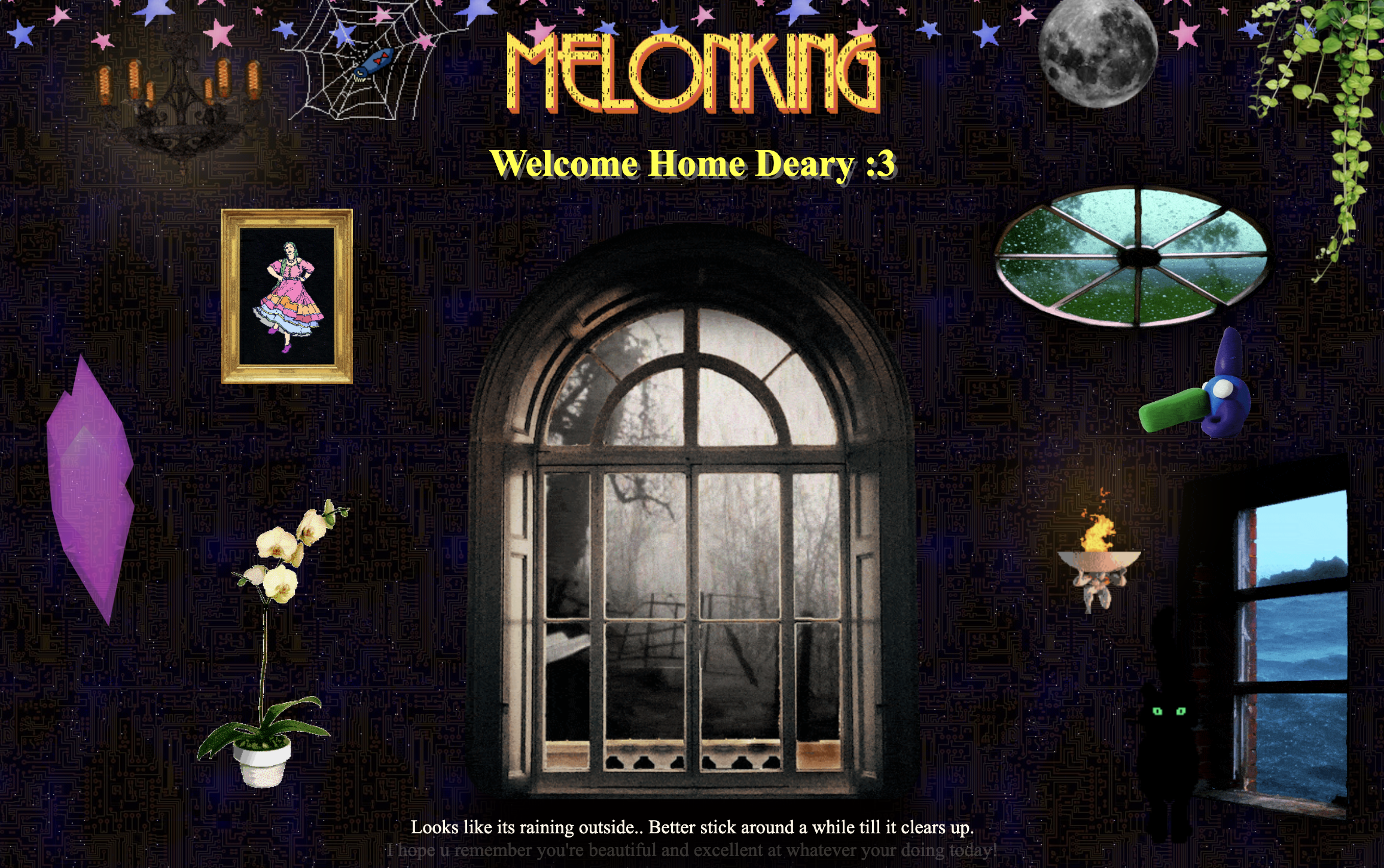

Melonking (fig. 1) is the nucleus of Daniel Murray’s extensive network of digital projects. Upon entering the website, the viewer has the option to click on a handful of hyperlinked gifs, all leading to different projects- asset archives, games, 3D modeled worlds, and more. This website really leans into the playful, exploratory nature of web 1.0, with unlabeled hyperlinks taking the curious user to new pages without explaining themselves.
Like many of the websites in this exhibition- illustrating the anticapitalist nature of Neocities- Melon provides visitors with a plethora of freely downloadable assets, and information on building their own website.
Melonking is a uniquely sophisticated Neocities site, and has a moderated forum on which members can ask questions, share art, and play on a joint Minecraft server.
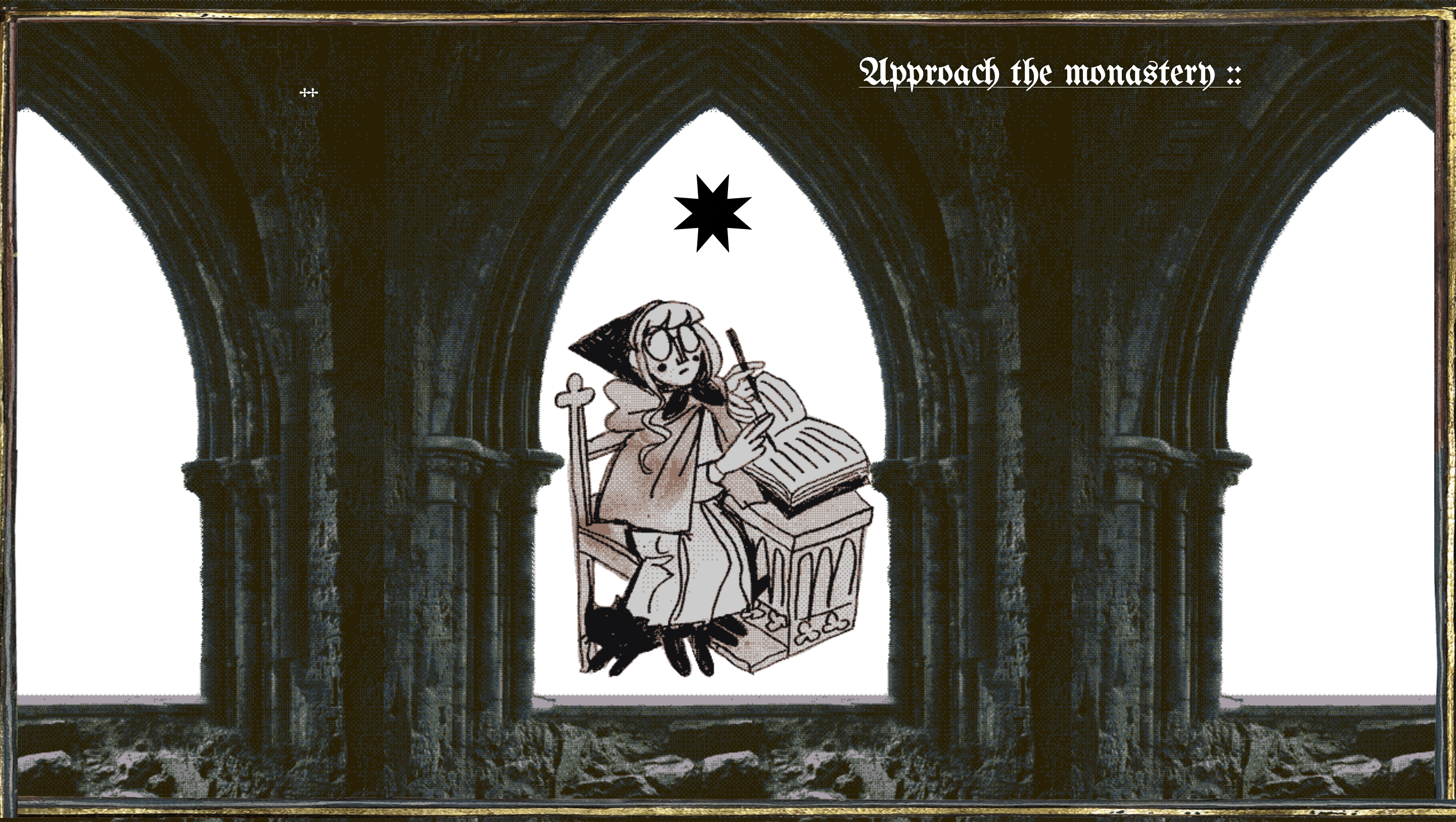

Monastery of St. Blamensir (fig. 2) is another beautiful example of an artist pushing the limits of HTML. Reminiscent of a point and click game, the user navigates through a "monastery" of scenes constructed from digital assets layered on top of one another. Most of the visuals appear to be either drawn by Blamensir themself, or pasted from medieval manuscripts- and there are dozens of pages that lead to different projects. Some are more artistic and obscure- such as the “Hortulus” filled with medieval plants to click on- while some are more practical. The book icon in the “Workshop”, for example, leads to a log where the website owner posts their DIY projects and art. The “Library & Archives” room in the Dormitory leads to a small annotated list of medieval codices, with links to download or view them digitally.
I highly recommend navigating this website from the landing page, as it’s a beautiful, immersive experience (with audio and easter eggs) to discover for the first time. However, some notable pages are:
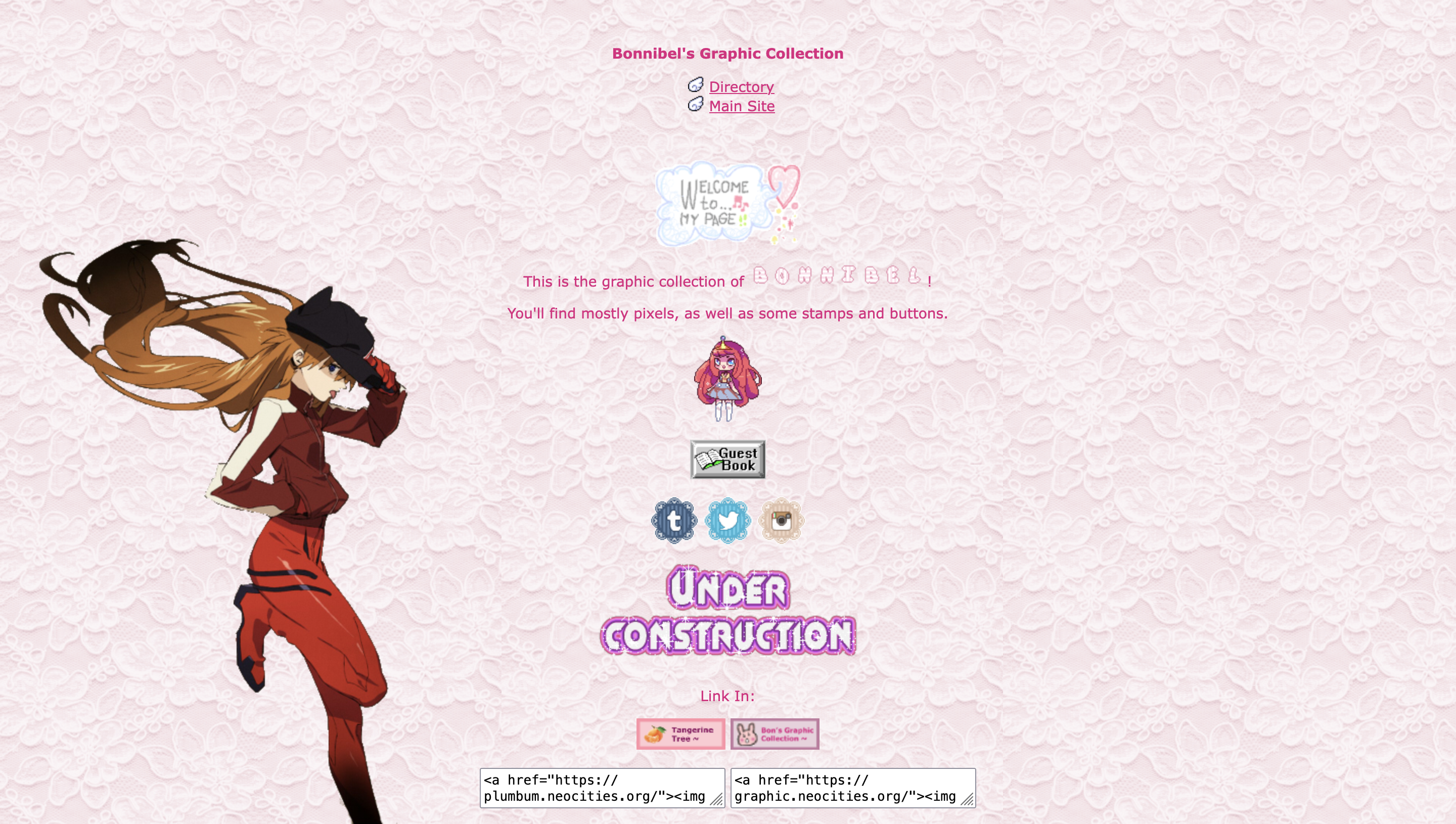

Bonnibel’s Graphic Collection (fig. 3) is the seventh most viewed website on Neocities, according to their website browser. It features a relatively sparse landing page, and a more or less utilitarian link directory- with pages for different categories of gifs and sprites (balloons, eyes, cats, and pokemon, to name a few). These files can either be downloaded for personal use, or hotlinked in HTML to appear on webpages.
This site is a good case study of the hazy nature of copyright in the context of the Web Revival and indie web. As demonstrated in the previous exhibition items and manifesto, web revivalists tend to share the attitude that digital content should be accessible to everybody, so resource pages are a common feature of Neocities sites. Although the “rules” are never explicitly stated (as “web revivalists” aren’t a cohesive group), generally webpages do not provide sources when using small gifs and sprites, as often they’ve been salvaged directly from defunct web 1.0 services like Geocities. Attribution tends to be reserved for gif collectors and archivists- one could thank a page like Bonnibel’s, for example, if they used her collection extensively on a website.
This obviously becomes an issue, however, when newer gifs and sprites are archived without credit, as their artists are likely still able to be found. In her "2024 Update", Bonnibel says she's slowly trying to find and link sources for all the files in the collection.
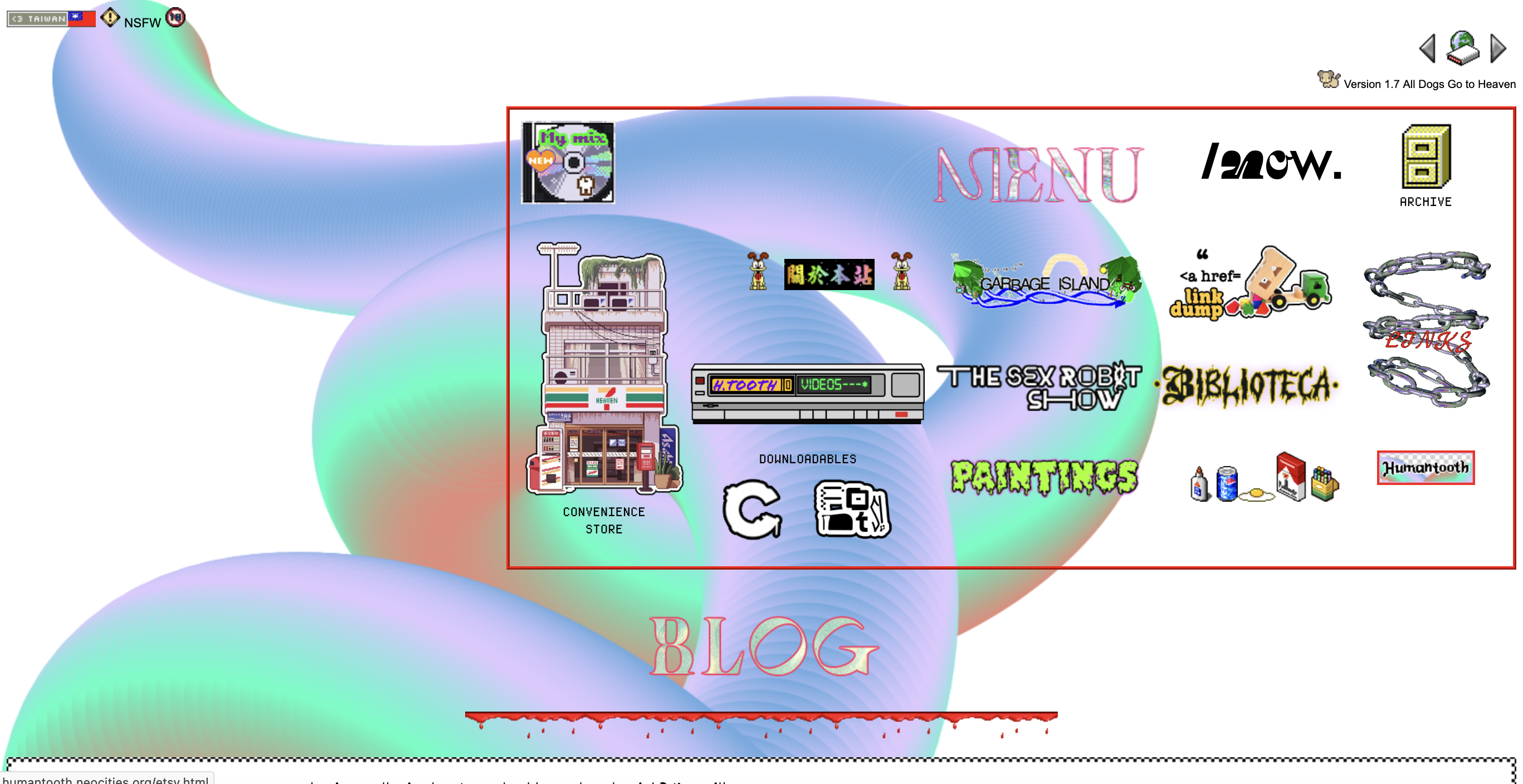

Humantooth (fig. 4) is a hodgepodge personal website filled with blog posts, resource lists, article links, and projects. This user’s resource page is substantial, with links to ebooks and movies, open source software, free fonts, conversion tools, and much more. They also have lines of HTML that viewers are free to copy and paste into their own webpages.
Perhaps most notably, Humantooth’s project The Sex Robot Show is an interesting example of how Neocities allows users to avoid the censorship they’d encounter on larger platforms. Proudly sporting a “Banned from Youtube” icon, the show’s About page explains that Humantooth wrote their Masters thesis on sex robots (for a “Futures Studies” program in Taipei), and that the Sex Robot Show came about as a way to share this data. Although these video essays aren’t hosted on Neocities, Humantooth’s website seems to be a main landing page for this project- something that likely wouldn’t be allowed (at least, not without a great deal of euphemism) on a platform like Instagram.
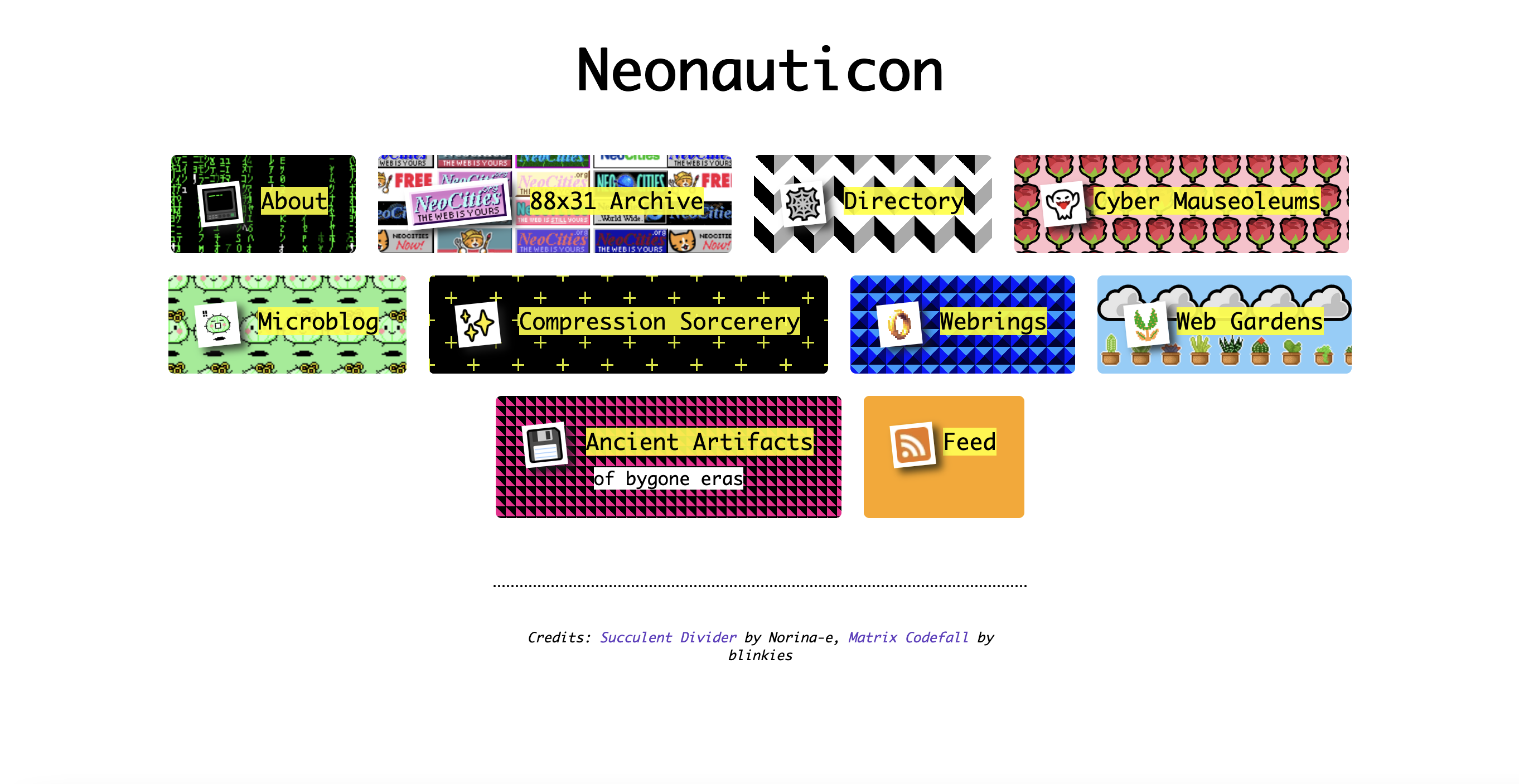

The owner describes Neonaut (fig. 5) as “a personal website documenting cyber culture, NeoCities, and various creative or Maker hobbies” (Neonaut). Perhaps more so than most web revivalists, Neonaut urges viewers to consider the longevity of their own Neocities websites. With pages on image compression and website optimization, Neonaut provides very practical advice about the often short lifespan of static websites- and how to extend them.
Although an HTML file itself is indestructible as long as it’s on a hard drive, hot links (that visit other websites to fetch content, rather than a file) can easily be broken if the website they link to goes down. In this way, static webpages are fragile- if one website in a web ring goes down, for example, the whole chain is broken. Neonaut references this “website death” on their "Cyber Mausoleum" page- an article urging webmasters to create a “tombstone” for sites they lose interest in, rather than just deleting them.
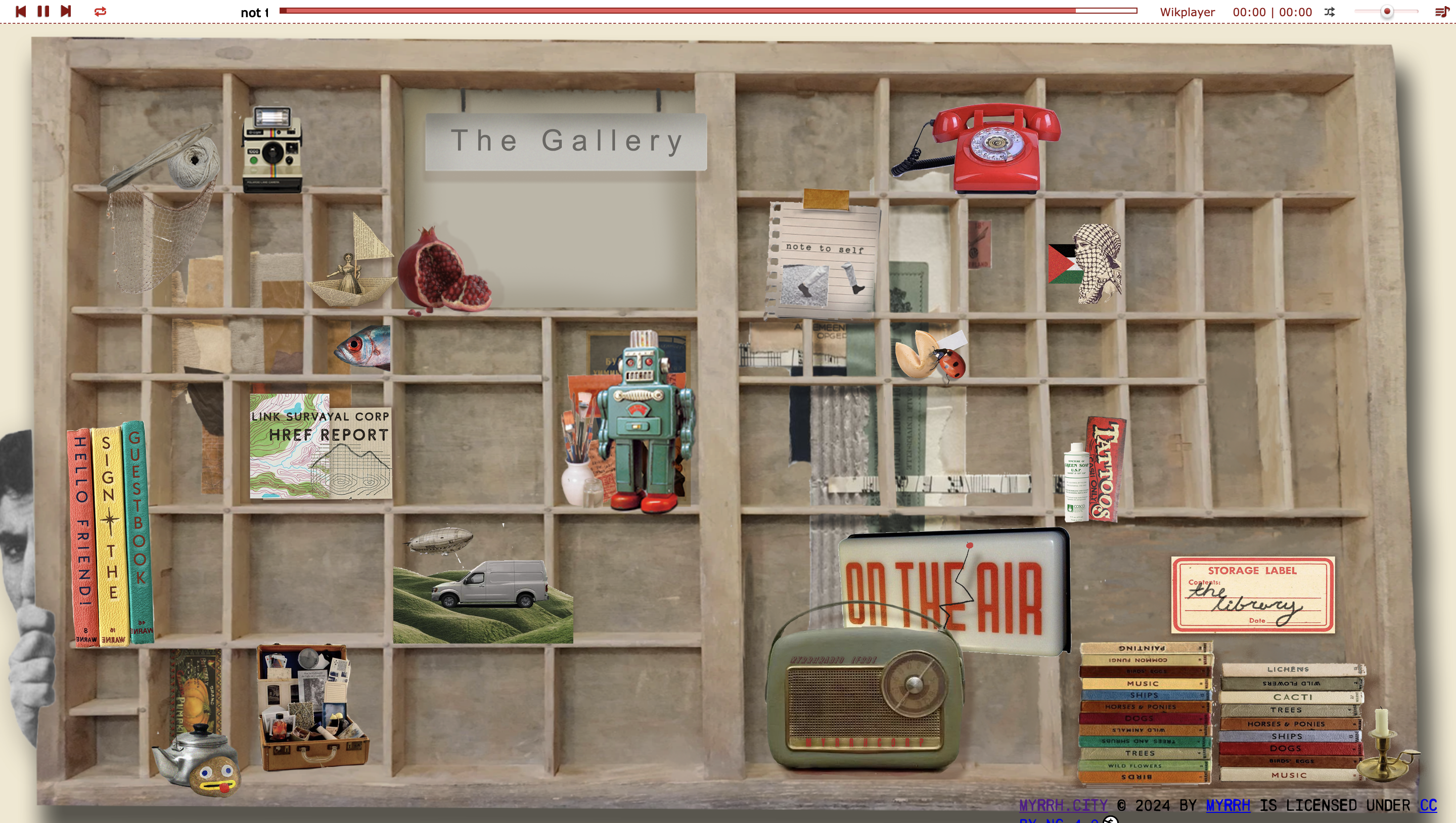

Myrrh City (fig. 6) is another beautiful example of a personal artist’s site, with lots of hidden pages to visit, and projects to view. This website seems to be more of a personal archive, with pages to view the owner’s sketchbooks, journals, and photographs. Their page labeled “The Gallery” functions almost like a portfolio, with a handful of labels leading to different work they’ve done professionally (as a scenic artist for Universal Studios, for example).
On their landing page, Myrrh includes a link to something called the “Public Access Platoon”: a “mail based art trade” which they started themself. The viewer can submit their name and address to Myrrh, and will receive blank postcards and postage at the beginning of every month to use for art-making. This is an interesting way for a static webpage webmaster to interact with their users- replacing the instantaneous connection of newer platforms (and even email) with an analog mail chain.
Allen, Matthew. “Web 2.0: An Argument Against Convergence”. First Monday, vol. 13, no. 3, Mar. 2008, https://doi.org/10.5210/fm.v13i3.2139.
Hayles, N. Katherine. “Print Is Flat, Code Is Deep: The Importance of Media-Specific Analysis”. Poetics Today, vol. 25, no 1, 2004, pp. 67-90.
Murray, Daniel. “Melon’s MANIFESTO”. Melonking, edited 22 December 2022, https://melonking.net/melon?z=/thoughts/manifesto. Accessed Dec 8 2025.
Neonaut. “neonaut@neocities:~$ about”. Neonaut, edited 5 Feb 2023, https://neonaut.neocities.org/about/. Accessed Dec 8 2025.
Wagner, Kate. “404 Page Not Found: The Internet Feeds on Its Own Dying Dreams.” The Baffler, no. 43, 2019, pp. 120–32. JSTOR, https://www.jstor.org/stable/26564968. Accessed 10 Dec. 2025.
Fig. 1. Still from Melonking home page. Melonking, https://melonking.net/melon?z=/home/. Accessed 9 Dec. 2025.
Fig. 2. Still from Blamensir landing page, Blamensir, https://blamensir.neocities.org/. Accessed 9 Dec. 2025.
Fig. 3. Still from Bonibell's Graphic Collection landing page, Bonnibell's Graphic Collection,https://graphic.neocities.org/ . Accessed 9 Dec. 2025.
Fig. 4. Still from Humantooth home page, Humantooth, https://humantooth.neocities.org/home. Accessed 9 Dec. 2025.
Fig. 5. Still from Neonaut landing page, Neonaut, https://neonaut.neocities.org/. Accessed 9 Dec. 2025.
Fig. 6. Still from Myrrh City home page, Myrrh.city, https://myrrh.city/desk. Accessed 9 Dec. 2025.